
Lawrence B. Conyers
Hominid Footprint Model Used to Test Antenna Frequencies and Field Methods for the Laetoli Site
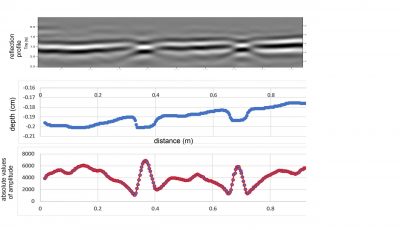
A footprint model was created in mud and covered in volcanic sand as a way to mimic conditions at the Laetoli, Tanzania site. Many antenna frequencies were tested with the buried prints uncovered, covered by plywood, and by a yoga mat. It was found that the yoga mat with the 2.6 GHz antennas produced the…
2 responses to “Hominid Footprint Model Used to Test Antenna Frequencies and Field Methods for the Laetoli Site”
-
A very helpful practical intro to high-frequency issues along with the particularities of foot impression reflections. I’m curious if migration tuned not to the RDP but experimentally determined by the impression wall reflection characteristics (probably different for MALE and FEMALE) might have sharpened the response allowing for a thinner slice and then, maybe, giving a better chance and 2D imaging. A 10cm slice map it too thick. Its clear that some type of automated processing is key if there is a lot of ground to cover. Very nice work.
-
thanks Tom. this dataset was not sliced. I had to pick the T-7 horizon and then export those depths to Surfer to produce the 3-D images. Slicing up these data was hopeless, as the stratigraphy is just too complicate. And migration also was no help, as my frequency filtering removed all the hyperbolas….
-
Leave a Reply